
🚁 eVTOL: The Future of Flying Is Already Here 🌍⚡A complete guide to the electric revolution in aviation — explained simply and beautifully.
🌟 What Is an eVTOL?
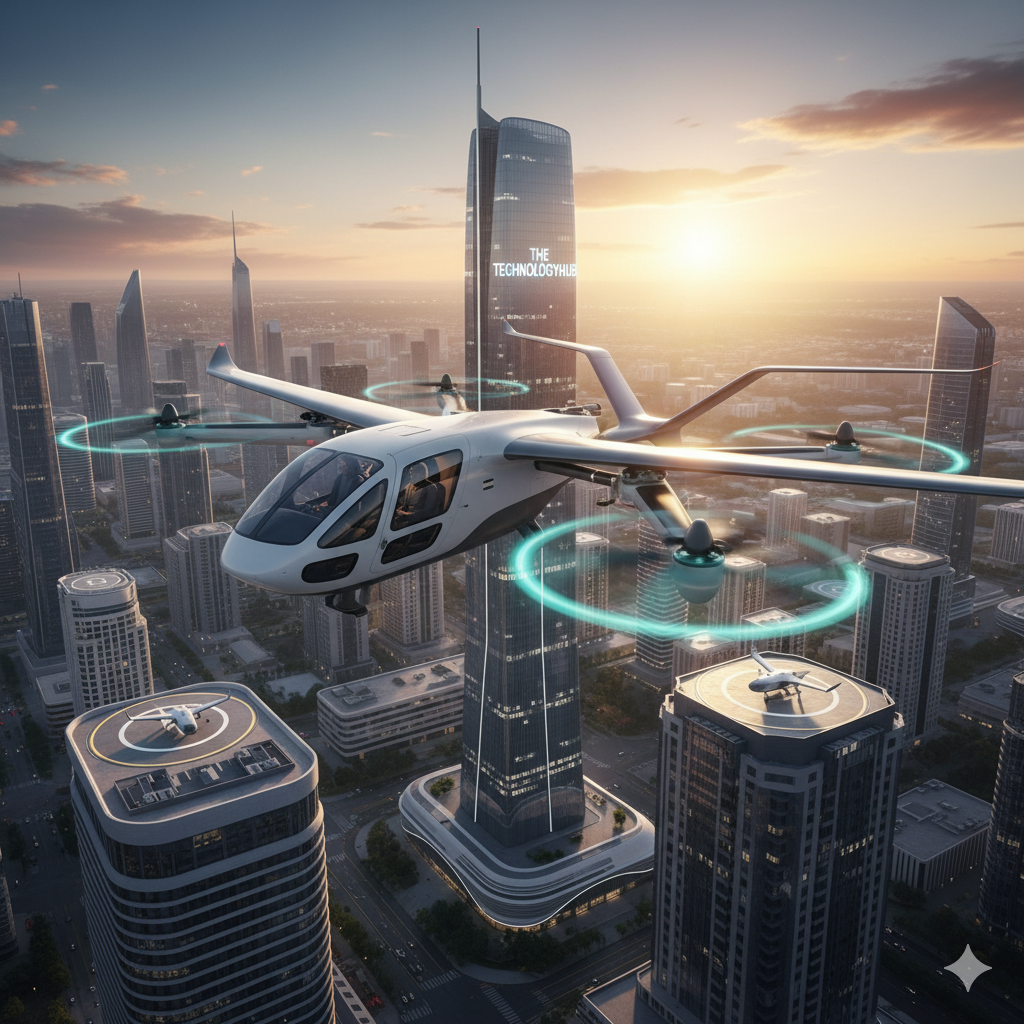
Picture this — you’re stuck in rush-hour traffic, the sun is setting, and your meeting starts in ten minutes.
Now imagine skipping all of that — you hop into a sleek aircraft, it lifts straight off the ground (no runway!), and in minutes, you’re flying over the city lights. ✨
That’s the magic of eVTOL, which stands for Electric Vertical Take-Off and Landing.
An eVTOL aircraft can take off, hover, and land vertically — just like a helicopter — but it runs on electric power, not fuel. That makes it quieter, cleaner, and smarter than anything the skies have ever seen. 🌿⚙️
In simple words:
eVTOLs are electric aircraft built to help us fly over traffic and pollution, not through it. 🚀
💚 Why eVTOLs Are Changing the World
eVTOLs represent more than innovation — they’re a symbol of how the world is reimagining mobility. 🌍
Here’s why the aviation industry is obsessed with them:
🌱 Eco-Friendly: Electric propulsion drastically cuts carbon emissions.
🏙️ Urban Air Mobility (UAM): Designed to operate in cities, connecting busy areas in minutes.
🤫 Low Noise: Special rotor designs make them quieter than traditional helicopters.
🛠️ Lower Maintenance: Fewer moving parts mean reduced costs and downtime.
🚁 Versatile Use: Passenger air taxis, emergency medical flights, cargo, and even tourism.
Experts predict that by 2035, thousands of eVTOLs will be flying daily — carrying people, parcels, and potential. 🌤️
⚙️ How eVTOLs Work — The Science Behind the Skies
At the heart of every eVTOL is a combination of engineering genius and clean power.
Here’s what makes it tick:
-
⚡ Electric Motors: Provide instant thrust, smoother control, and quieter operation.
-
🔋 High-Performance Batteries: Supply energy to multiple rotors and flight systems.
-
🧠 Smart Control Systems: AI-powered software balances and guides the aircraft.
-
🪶 Lightweight Composites: Keep the aircraft light but durable for safe, long flights.
-
🔇 Noise Reduction Tech: Makes them nearly silent during takeoff and landing.
This blend of hardware and intelligence allows eVTOLs to operate safely in dense urban environments. 🚏✨
🧩 Different Designs of eVTOLs
The term “eVTOL” covers a range of designs. Here are the main ones:
-
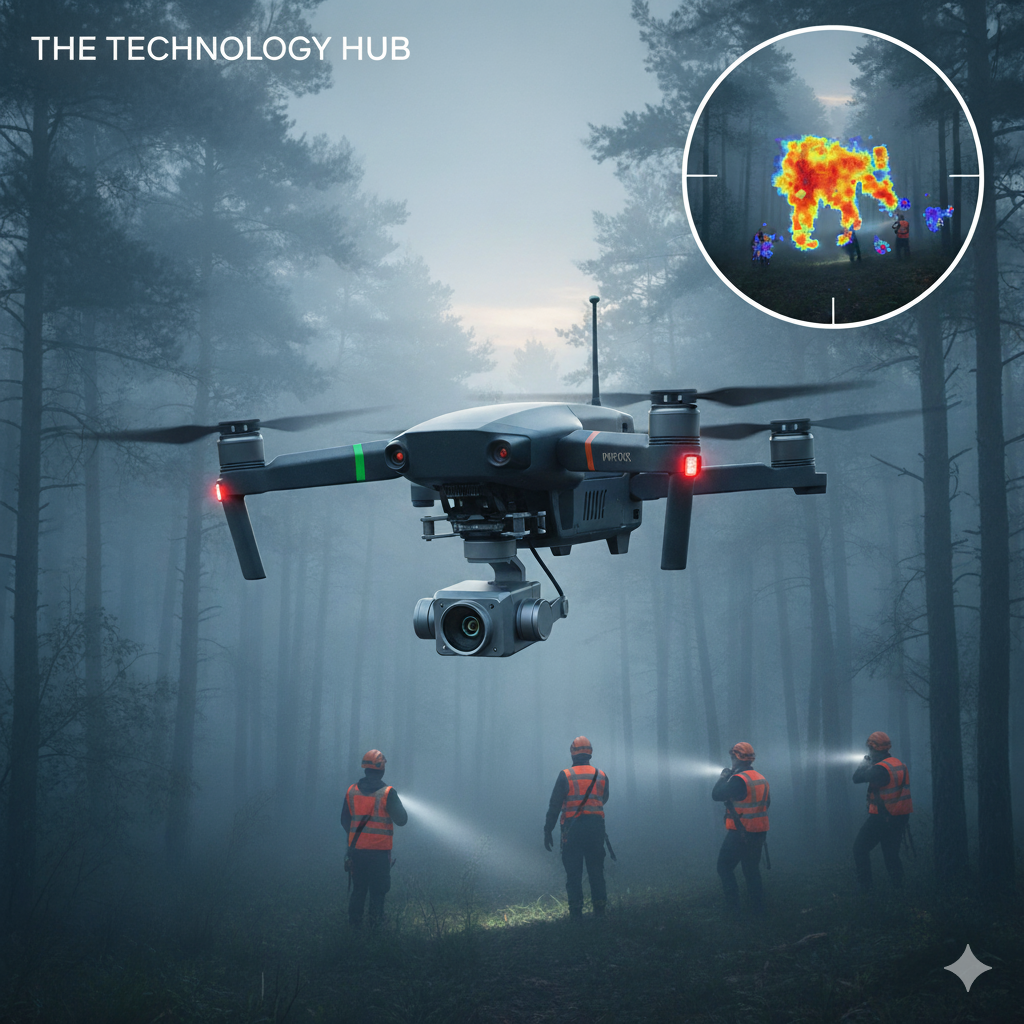
Multirotor: Looks like a large drone; great at hovering but limited range.
-
Lift + Cruise: Separate motors for lift and forward flight — more efficient.
-
Tilt-Rotor / Tilt-Wing: Rotors or wings tilt during transition for faster flight.
-
Hybrid-Electric: Combines batteries with fuel cells or small engines for extended range.
Each design is a trade-off — balancing flight speed, range, noise, and cost. ✈️
🔋 The Battery Challenge — The Heart of the Revolution
Batteries are both the engine and the obstacle for eVTOL innovation.
Most current models use lithium-ion batteries, providing around 30–90 minutes of flight time depending on payload and weather. But that’s improving fast! 🚀
Researchers are testing:
🔹 Solid-State Batteries – Higher energy density and less fire risk.
🔹 Hydrogen Fuel Cells – Longer range and quicker refueling.
🔹 Hybrid Systems – Combining fuel and electric for maximum endurance.
Better batteries mean longer flights, cheaper fares, and safer skies.
In other words — whoever wins the battery race, wins the eVTOL future. ⚡
🤖 Autonomy, AI, and the Smart Future of Flight
The next generation of eVTOLs won’t just fly — they’ll think. 🧠✨
Many prototypes already use artificial intelligence (AI) to assist with:
-
Automatic takeoff and landing
-
Obstacle detection (using LiDAR and cameras)
-
Real-time route optimization
-
Weather and energy management
While human pilots will control early versions, fully autonomous eVTOLs are on the horizon.
Imagine booking an air taxi through an app — no pilot needed. Just a seat, a sky, and AI. 🌤️
🛫 Regulation, Safety & Certification
Safety is everything in aviation — and eVTOLs are no exception.
Authorities like the FAA and EASA are developing new certification standards specifically for electric-powered lift aircraft. These include:
✅ Battery containment & fireproofing
✅ Redundant control systems
✅ Parachute recovery systems
✅ Pilot training & maintenance standards
The goal?
To make eVTOLs as safe as commercial airplanes — but far cleaner and quieter. ✈️💚
🏗️ Infrastructure: Vertiports and Charging Networks
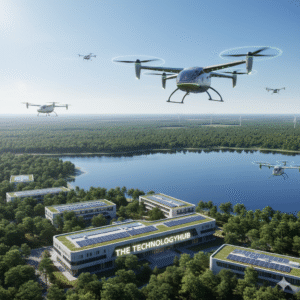
To make eVTOLs practical, cities need special mini-airports — called vertiports. 🏙️
A vertiport is a compact hub designed for:
⚡ Fast charging and battery swaps
🧭 Air traffic coordination
👥 Passenger handling
🌞 Renewable power integration
In the near future, rooftop vertiports could become as common as petrol stations are today — only cleaner, quieter, and smarter. 🌿⚡
🔇 Quiet Skies — Tackling the Noise Issue
Noise pollution can make or break eVTOL success. People love clean tech, but not noisy neighbors in the sky!
That’s why eVTOL manufacturers invest in acoustic modeling, designing rotor blades and flight paths that minimize sound impact.
The result?
Flights that are quieter than a dishwasher, even during takeoff. 🤫💨
💼 Leading eVTOL Companies You Should Know
The race for the skies is heating up! Here are the pioneers shaping the industry:
🚀 Joby Aviation – Sleek design, long range (~150 miles), whisper-quiet operations.
✈️ Archer Aviation (Midnight) – Focused on urban air taxi routes with 4-seat cabins.
🛩️ Vertical Aerospace (VX4) – Aims for airline-level certification and safety.
🤖 EHang (EH216) – Fully autonomous, already conducting demonstration flights.
💡 Lilium Jet – Unique ducted-fan design for longer-range regional transport.
These companies are rewriting aviation history — turning dreams into data, and data into flight. 💫
💰 How Much Does an eVTOL Cost?
The cost of eVTOLs depends on their type, capacity, and technology.
-
Personal or prototype models: Start around $300,000–$600,000.
-
Commercial air taxis (Joby, Archer): Expected to range from $1 million to $3 million per unit.
As production scales up, prices will drop — just like electric cars. In a decade, short urban air taxi rides may cost the same as an Uber trip today! 🚖✨
🌤️ How High Do eVTOLs Fly?
Most eVTOLs are designed to fly at 1,500–5,000 feet (450–1,500 meters) above ground — safely below commercial airliners but above city buildings.
This sweet spot allows them to:
🛫 Avoid congestion
🔋 Conserve battery power
📡 Communicate clearly with ground systems
It’s like having a personal sky lane for urban travelers. ☁️
🧭 Who’s Leading in the eVTOL Race?
Several companies are leading the innovation game, but Joby Aviation currently stands out.
Why?
-
Proven flight tests with real passengers
-
Longest range (~150 miles)
-
Quietest operation
-
Partnership with NASA and global air mobility networks
But Archer, Lilium, and EHang are catching up fast, each bringing unique designs and goals to the table.
Competition means faster progress — and that’s great news for the world. 🌎🚁
✈️ Is eVTOL a Drone?
Technically, no — though they share DNA.
Both eVTOLs and drones can hover and use electric motors.
But eVTOLs are much larger, passenger-rated aircraft, built with advanced safety systems and certified under strict aviation standards.
You could say:
“All eVTOLs are like giant drones, but not all drones are eVTOLs.” 😉
🧩 Can I Buy an eVTOL?
Surprisingly, yes — but not quite like buying a car (yet).
Some companies offer pre-orders for personal or training models, while commercial eVTOLs will likely operate under ride-sharing services first.
In the next few years, you might be able to book your first “air taxi” ride right from your phone. 📱🚁
🌱 Is eVTOL the Future?
Absolutely.
eVTOLs represent a revolution in sustainable aviation — cleaner skies, faster commutes, and quieter cities.
They could connect rural areas, reduce urban congestion, and open new horizons for emergency response and logistics.
It’s not “if” — it’s “when.” 🌤️💚
🚁 Why Is Joby Better Than a Helicopter?
Joby’s eVTOL offers what helicopters can’t:
💨 Quieter Flights: 100x quieter during takeoff.
🌿 Cleaner Energy: Fully electric, no fuel emissions.
⚙️ Lower Cost per Hour: Fewer moving parts = less maintenance.
🪶 Lighter Design: Optimized aerodynamics for smooth efficiency.
Imagine all the benefits of a helicopter — without the noise, pollution, or cost. That’s Joby’s promise. ✨
🏢 Who Is Bigger Than Boeing in the eVTOL World?
While Boeing is still a global aerospace leader, the eVTOL revolution is being led by new-generation innovators like:
-
Joby Aviation
-
Archer
-
Lilium
-
EHang
These startups are smaller but faster — and often backed by aviation giants, including Boeing itself (which invests in several eVTOL ventures).
So, rather than competition, it’s a collaboration shaping the next chapter of aviation. 🌍✈️
🌤️ The Dawn of a New Era in Flight 🚁💫
As we stand at the edge of a new aviation revolution, eVTOLs symbolize more than technology — they represent hope, innovation, and a cleaner tomorrow. 🌍⚡
For decades, flying was a dream reserved for pilots, airlines, and those with access to airports. But now, with eVTOLs, that dream is coming closer to everyday life — a sky that belongs to everyone. ☁️✨
These electric aircraft are not just changing how we move — they’re changing how we think about cities, energy, and connection. Imagine a future where:
-
You leave your rooftop office and fly home above traffic 🚗💨
-
Emergency responders reach disaster zones in minutes 🚑⚡
-
Deliveries and logistics run cleanly, powered by renewable energy 🌱📦
-
Remote villages connect seamlessly with urban hubs, closing distance and inequality 🌍🤝
That’s the promise of eVTOLs — a world where mobility meets sustainability, and progress doesn’t come at the cost of the planet. 🌿
But this transformation won’t happen overnight. It requires collaboration between engineers, policymakers, and dreamers — people who believe that clean skies and quiet cities are possible.
Every challenge — from battery innovation to air traffic management — is being met with creativity and courage. And every flight test brings us one step closer to turning science fiction into everyday reality. 🚀
Soon, we won’t just look up and see airplanes; we’ll see the future — sleek, electric, and human-centered.
Because eVTOLs aren’t just aircraft; they’re a vision of freedom — freedom from congestion, noise, pollution, and limits.
They’re proof that innovation can serve people and the planet together. 🌎💚
The sky is no longer the limit — it’s the beginning.
The eVTOL era has arrived. ✨🚁